When a waveguide component is described as space flight qualified, that phrase carries specific engineering weight. It is not a marketing claim or a general indicator of quality. It is a documented, testable status that tells a program engineer exactly what the component has been designed and verified to survive — and what records exist to prove it. For aerospace programs where replacement during operation is not possible, space flight qualification is one of the most consequential specifications a waveguide manufacturer can meet.
What space flight qualification actually involves
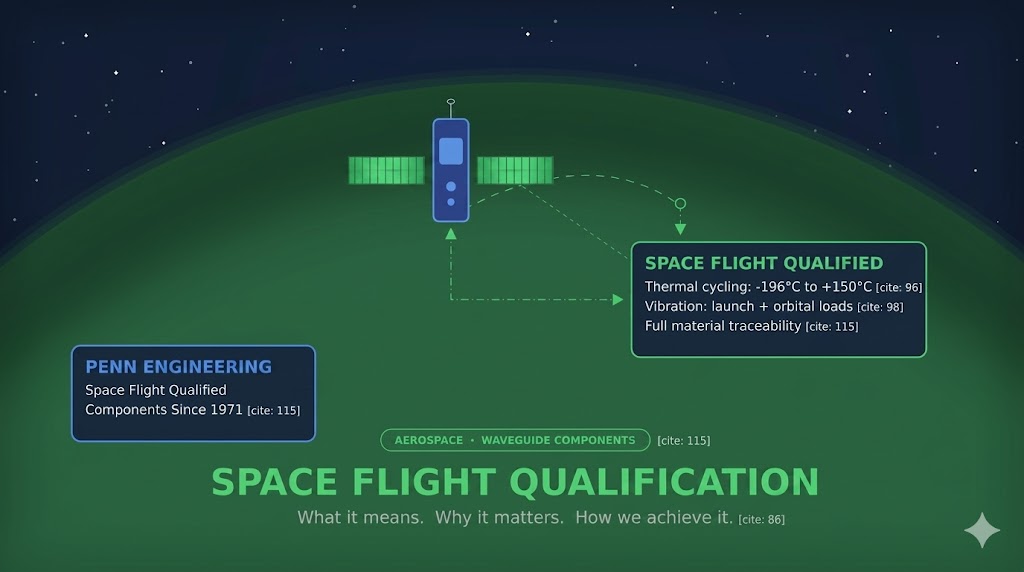
Space flight qualification is a process, not a single test. It requires that a component design be subjected to — and survive — a defined set of environmental stress conditions that simulate the full lifecycle of a space mission. For waveguide components, this typically includes:
Thermal cycling
Repeated cycling from cryogenic temperatures (as low as -196°C in some programs) to sustained high-heat conditions, verifying that dimensional tolerances and RF performance characteristics do not drift across the operational temperature range.
Vibration and acoustic testing
Exposure to the vibration profiles and acoustic loads associated with launch, confirming that no loosening, misalignment, or mechanical fatigue occurs in the component’s structure or at its flange interfaces.
Vacuum compatibility
Verification that materials do not outgas in a way that would contaminate optical surfaces, degrade adjacent components, or compromise the satellite’s internal environment.
Shock testing
Simulation of stage separation and deployment events, which generate brief but intense mechanical shock loads throughout the vehicle structure.
Dimensional and RF verification
Full dimensional inspection and RF characterization before and after environmental testing to confirm that performance has not degraded. Each of these steps generates documentation — test reports, dimensional records, material certifications — that form the qualification package accompanying the component.
Why it matters more than standard aerospace certification
Many components described as aerospace-grade have been designed and manufactured to tight tolerances and may have been used successfully in airborne applications. That is a meaningful standard. But airborne and space environments are not equivalent.
The thermal extremes in orbit are more severe than those encountered in atmospheric flight. The vacuum environment introduces outgassing requirements that ground and airborne programs do not face. Launch loads are a one-time, high-intensity mechanical event with no equivalent in operational aircraft. And critically — if a component fails on orbit, there is no maintenance access, no replacement, and no second chance.
Space flight qualification exists precisely because these distinctions are real and consequential.
How Penn Engineering achieves it
Penn Engineering Components has been manufacturing waveguide assemblies for space programs since 1971. Our California-based team produces components with full material traceability, documented dimensional inspection at every production stage, and process certifications that support customer qualification programs.
We do not simply build to print and ship. We maintain the documentation infrastructure that space programs require: first article inspection records, material test reports, process certifications for plating and finishing operations, and dimensional data packages. When a customer’s qualification engineer needs records, they exist.
For programs requiring specific qualification testing, we work directly with customers and their test laboratories to ensure components are built to the configuration that will be qualified — not a surrogate that diverges from the flight configuration.
For your next space program
Whether you are specifying components for a new satellite bus, a launch vehicle RF system, or a ground station that supports space operations, Penn Engineering Components can provide the parts and the paperwork your program requires. Contact our engineering team to discuss your qualification requirements.
Ready to discuss space flight qualification requirements for your program?
Connect With Our Sales Team
To discuss your defense systems and waveguide requirements