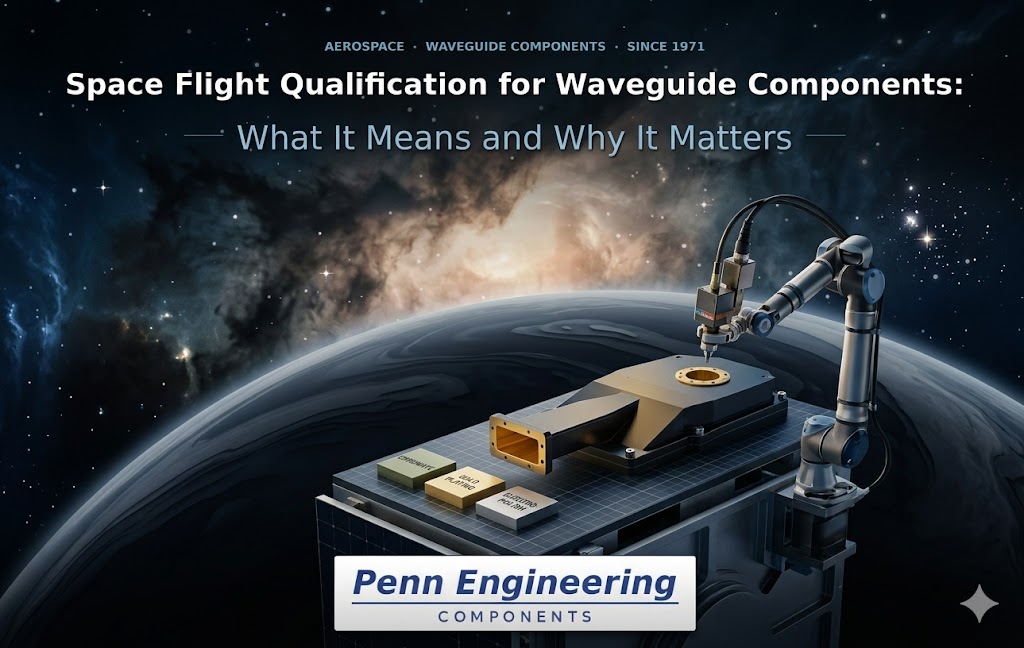
Launch vehicle and satellite programs place unique demands on waveguide components that go well beyond the requirements of typical airborne or ground-based RF systems. The physical environment these components must survive — from the mechanical violence of launch to the thermal extremes and vacuum conditions of orbit — requires deliberate engineering at every stage of design, manufacturing, and documentation. Penn Engineering Components has supplied waveguide assemblies to launch vehicle and satellite programs for over five decades.
The two environments: launch and orbit
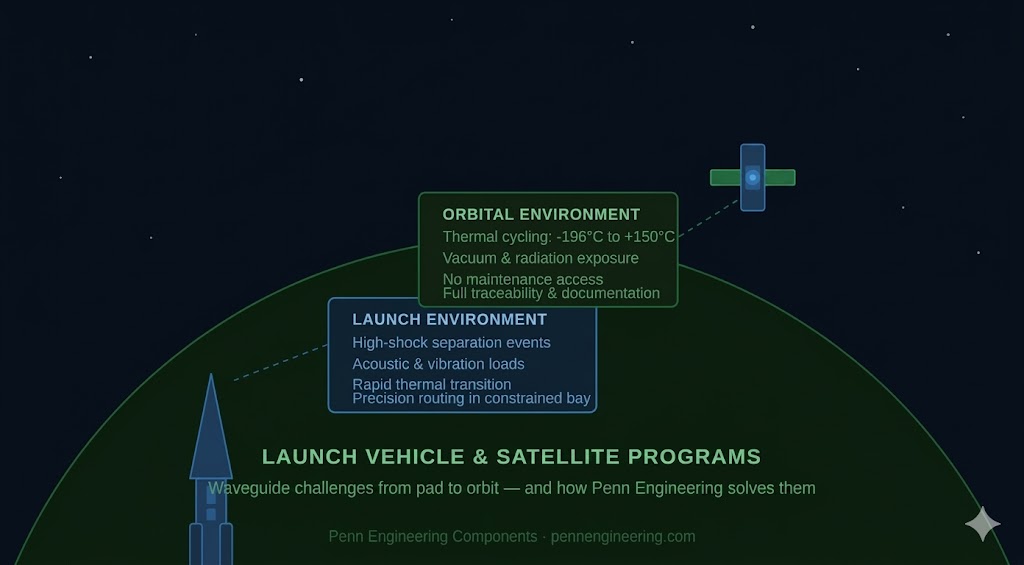
A waveguide component used in a launch vehicle or satellite faces two fundamentally different and sequential stress environments.
The first is the launch environment — a relatively brief but mechanically intense period that includes sustained vibration from propulsion systems, broadband acoustic energy from engine exhaust impingement on the vehicle structure, and sharp mechanical shock events at stage separation and payload deployment.
The second is the orbital environment — potentially years of operation in vacuum, exposed to cyclical temperature swings driven by transitions between sunlit and shadowed portions of the orbit, and subject to radiation levels that have no equivalent in atmospheric flight. Components must perform reliably for the full operational lifetime of the satellite — which for commercial programs is typically 15 years or more.
Both environments must be designed from the outset. A component that survives launch but degrades over five years on orbit has failed its program requirements just as surely as one that fails during vibration testing.
Dimensional stability across extreme thermal cycles
In orbit, a satellite in low Earth orbit may experience 15 or more thermal cycles per day as it transitions between sunlight and Earth’s shadow. Each cycle can span more than 200°C depending on the component’s location, surface finish, and thermal connection to the satellite structure.
For waveguide components, these thermal cycles create dimensional challenges. Different materials expand and contract at different rates. A waveguide assembly that incorporates aluminum sections, stainless steel flanges, and silver-plated internal surfaces will experience differential expansion at every interface with every thermal cycle. If the design does not account for this — or if manufacturing tolerances are insufficiently controlled — the cumulative effect is dimensional drift, flange interface degradation, and eventual RF performance degradation.
Penn Engineering machines waveguide components to tight dimensional tolerances specifically to provide the stability margin that thermal cycling programs require. Our quality inspection process verifies dimensional compliance at production, providing baseline data that supports customer thermal analysis and qualification planning.
Mechanical integrity through launch loads
Vibration and acoustic loads during launch are transmitted through the entire vehicle structure. For waveguide assemblies mounted in the payload bay or within the launch vehicle’s avionics section, these loads can be significant.
The primary concern is not catastrophic fracture — properly designed metallic waveguide components have substantial structural margins against that failure mode. The concern is more subtle: loosening of fasteners at flange joints, fretting at mating surfaces, and fatigue of thin-wall sections under sustained vibration. Any of these can introduce increased insertion loss, impedance discontinuities, or physical misalignment that degrades system performance.
Penn Engineering designs and manufactures waveguide assemblies with the mechanical robustness that launch environments demand. Flange interfaces are machined to ensure proper contact and clamping force. Wall thicknesses are specified to provide adequate stiffness without unnecessary mass penalty. And for programs with specific vibration requirements, we can work with customers to review designs against their load specifications before manufacturing begins.
Documentation and traceability requirements
Perhaps the most underappreciated challenge of launch vehicle and satellite programs is the documentation burden. Space programs require levels of material traceability, process documentation, and inspection record-keeping that most commercial manufacturing programs do not approach.
Every material lot must be traceable to its origin. Every plating or finishing operation must be documented with process parameters. Dimensional inspection must be performed and recorded at defined stages of production. First article inspection reports, material test reports, and certificates of conformance must accompany the hardware.
These requirements exist because space programs have no maintenance access after launch. The documentation that ships with the hardware is the only record of what the component is, how it was made, and whether it met its requirements. When a failure investigation is needed years after launch, those records are indispensable.
Penn Engineering maintains the quality management infrastructure to meet these documentation requirements. Our ISO 9001-certified quality system supports the traceability and record-keeping that space programs demand, and our engineering team is experienced in working with customers’ quality organizations to confirm that specific program documentation requirements are met before production begins.
Working with Penn Engineering on your space program
If you are specifying waveguide components for a launch vehicle RF system, a satellite payload, or a ground station supporting space operations, Penn Engineering Components has the manufacturing capability, quality infrastructure, and program experience to support your requirements.
We welcome the opportunity to review your drawings and specifications early in the program — before designs are finalized — to confirm manufacturability and identify any dimensional or finishing requirements that may affect lead time or cost. Contact our engineering team to start that conversation.
Specifying waveguide components for a launch vehicle or satellite program?
Connect With Our Sales Team
To discuss your defense systems and waveguide requirements