
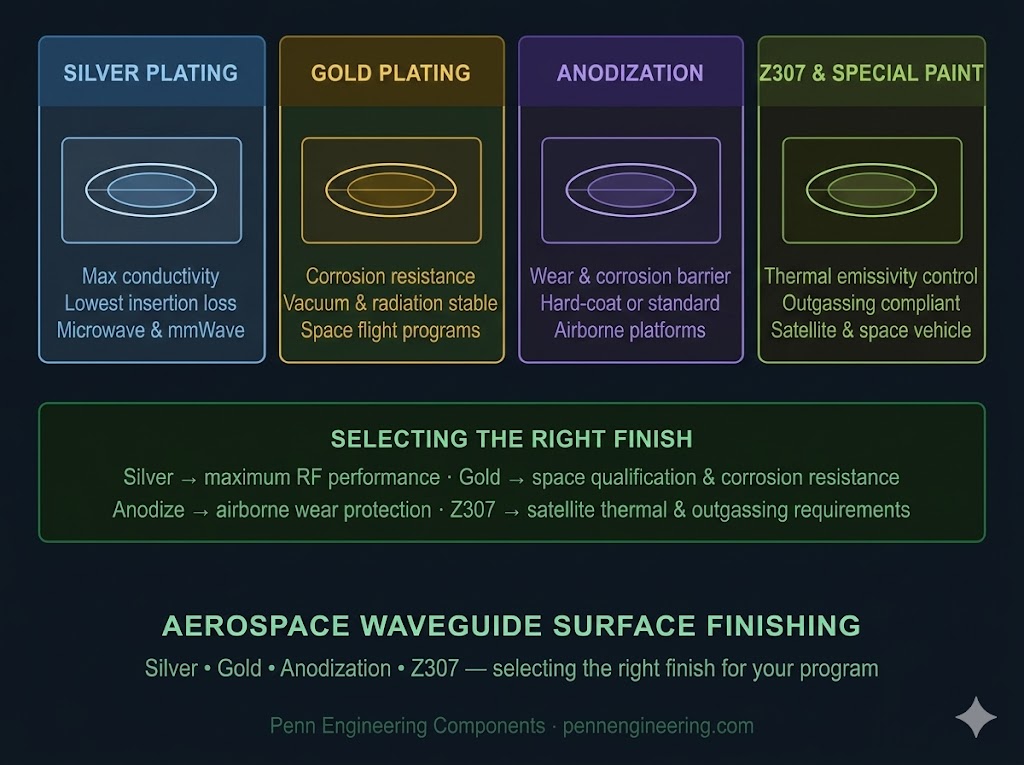
Surface finish is not a cosmetic decision on a waveguide component. In aerospace applications, the finish applied to a waveguide assembly directly affects RF performance, corrosion resistance, thermal behavior, and long-term reliability — all of which have meaningful consequences for the platform it supports. Penn Engineering Components applies four primary aerospace-grade surface finishing processes: silver plating, gold plating, anodization, and Z307 and special paint systems. Each serves a distinct engineering purpose, and selecting the right one depends on the application environment, frequency range, and program specifications.
Silver plating — maximum RF performance
Silver is the most electrically conductive metal available for practical plating applications, which makes it the standard finish for waveguide components where insertion loss is the primary concern. At microwave and millimeter-wave frequencies, RF current flows primarily in a thin layer at the conductor surface — a phenomenon known as the skin effect. The higher the surface conductivity, the lower the resistive losses in that surface layer.
For radar systems, high-gain antenna feeds, and precision communication links where every fraction of a decibel matters, silver plating is typically the correct choice. It is widely specified across commercial and defense aerospace programs operating from S-band through millimeter-wave frequencies.
The practical limitation of silver is tarnishing in humid or sulfur-bearing environments, which can increase surface resistance over time. For sealed or controlled environments — such as pressurized avionics bays or hermetically sealed assemblies — tarnishing is not a concern. For exposed installations, a protective overcoat or an alternative finish may be appropriate.
Gold plating — space qualification and corrosion resistance
Gold plating is the standard finish for waveguide components in space applications. Its primary advantages are exceptional corrosion resistance, stability in vacuum environments, and compatibility with thermal cycling and radiation exposure conditions of orbital missions.
Gold does not tarnish and does not react with the contaminants typically present in spacecraft manufacturing and assembly environments. It maintains consistent contact resistance at waveguide flange interfaces over the full temperature range of the mission, which is critical for components that will never be accessed after launch.
Gold plating is also commonly specified on connector interfaces and contact surfaces where a reliable, stable electrical connection must be maintained over the component’s full service life — which for satellite programs is measured in years or decades.
Anodization — wear and corrosion protection for airborne platforms
Anodization is an electrochemical process that converts the surface of an aluminum component into a dense, hard aluminum oxide layer. It is not a coating applied on top of the metal — it is a transformation of the metal surface itself, which means it cannot peel or flake under mechanical stress.
For airborne waveguide assemblies — in aircraft avionics bays, on UAV platforms, or in ground-based systems exposed to weather — anodization provides meaningful protection against wear, scratching, and corrosion without significantly changing the component’s dimensional profile. Hard-coat anodization produces a thicker, denser layer and is specified when abrasion resistance is a primary requirement.
Anodization is typically applied to aluminum components. It is compatible with subsequent assembly processes and does not interfere with flange mating when applied to appropriate tolerances.
Z307 and special paint systems — thermal emissivity and outgassing control
On satellites and space vehicles, components are subject to radiative thermal environments that have no equivalent in atmospheric flight. The thermal emissivity of a component’s surface — how efficiently it radiates heat — directly affects its temperature in orbit, which in turn affects dimensional stability and RF performance.
Z307 is a paint system commonly specified for spacecraft components where controlled thermal emissivity is required. It provides a stable, low-outgassing surface finish that meets the stringent outgassing requirements of spacecraft programs, preventing contamination of optical surfaces and sensitive instruments.
Beyond Z307, Penn Engineering can apply other program-specified paint and coating systems based on customer drawings and specifications. The specific system selected depends on the thermal environment, outgassing requirements, and compatibility requirements of adjacent components and materials.
Choosing the right finish
Most aerospace waveguide programs specify finish requirements in the component drawing or procurement specification. Where specifications allow engineering judgment, the general guidance is:
- For RF performance in a stable environment: silver plating
- For space applications requiring corrosion resistance and vacuum stability: gold plating
- For airborne aluminum components requiring wear and corrosion protection: anodization
- For satellite and space vehicle components with thermal emissivity or outgassing requirements: Z307 or program-specified paint
Penn Engineering’s engineering team can review your drawings and application requirements to confirm the appropriate finish for your program. Contact us to discuss your specifications.
Ready to discuss space flight qualification requirements for your program?
Connect With Our Sales Team
To discuss your defense systems and waveguide requirements