Sourcing a custom waveguide assembly requires clear, unambiguous documentation from the start. Incomplete technical packages often cause quoting bottlenecks, unexpected Design for Manufacturability (DFM) revisions, and extended lead times. You may be routing high-frequency signals inside tight aerospace enclosures or developing specialized radar subsystems. Defining your exact custom waveguide assembly specifications upfront ensures your custom waveguides meet electrical and mechanical tolerances from day one.
Off-the-shelf rigid or flexible sections cannot always accommodate complex routing paths or tight mechanical envelopes. In those cases, a custom-engineered waveguide assembly bridges the gap between system architecture and repeatable production. Complete upfront documentation allows RF and mechanical engineers to validate bend radii, braze joints, and plating compatibility before tooling begins.
Use this engineering checklist to verify your RFQ package before submitting drawings for quote.
Custom Waveguide Assembly Specifications Checklist
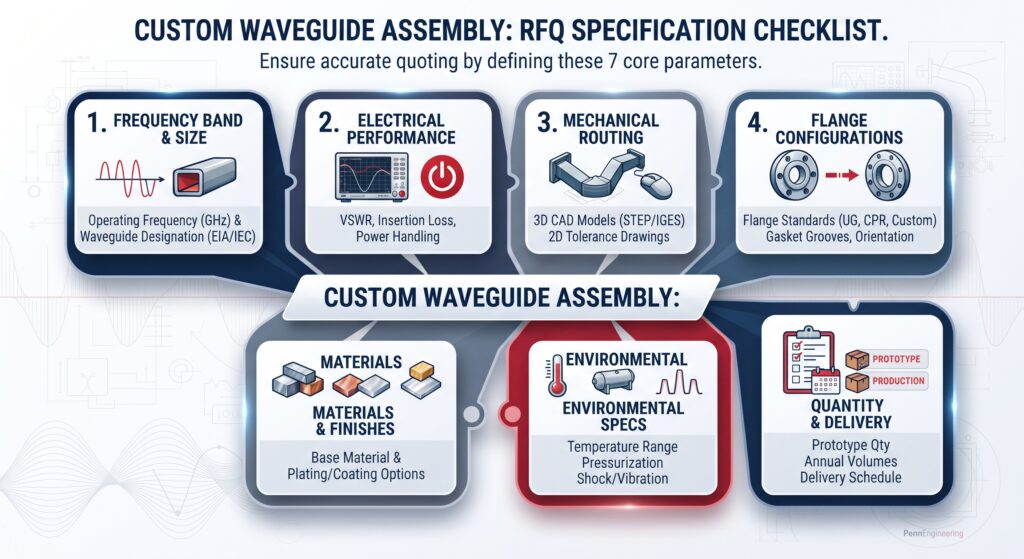
Before requesting a quote for a custom waveguide, confirm that your technical package defines these seven core parameters:
✔️ Frequency Band & Waveguide Size: State the operating frequency range (GHz) and standard EIA waveguide designation or IEC rectangular/double-ridge size (such as WR-90, WR-75, or WR-42) to establish baseline cutoff frequencies and internal dimensions.
✔️ Electrical Performance Requirements: Specify maximum allowable VSWR, insertion loss limits, and port-to-port isolation. Include both peak and average power-handling ratings across your operating band.
✔️ Mechanical Envelope & 3D Routing: Attach native 3D CAD models (STEP/IGES) and 2D tolerance drawings detailing E-plane and H-plane bend radii, twist angles, overall path length, and critical mounting interfaces.
✔️ Flange Types & Orientation: Identify exact flange standards (such as MIL-DTL-3922 UG cover, choke, CPR, or custom interface flanges), O-ring/gasket grooves, and flange clocking angles.
✔️ Base Materials & Surface Finishes: List preferred base alloys, including oxygen-free copper, aluminum 6061, brass, or Invar. Specify internal and external plating or coatings—such as silver, gold, chem-film, or passivation—for conductivity and corrosion protection.
✔️ Environmental & RF Testing Specs: Outline operating temperature extremes, internal pressurization, or hermeticity requirements. Detail shock and vibration profiles along with mandatory Vector Network Analyzer (VNA) sweep testing.
✔️ Quantity & Delivery Milestones: Include prototype quantities, forecasted annual production volumes, and target delivery schedules to align tooling and manufacturing capacity.
Ready to Move Your Design Forward?
Our engineering team reviews your mechanical drawings and RF parameters to optimize manufacturability and deliver an accurate quote. Submit your technical package directly to discuss your defense systems and custom waveguide requirements.
To discuss your defense systems and waveguide requirements