
In defense RF systems, performance is not determined by individual components alone — it is defined by how those components are assembled.
Even when straight sections, bends, and flanges are machined to tight tolerances, improper assembly can introduce misalignment, cumulative tolerance stack-up, and measurable RF degradation. In mission-critical systems, small assembly errors can translate into increased insertion loss, higher VSWR, and reduced repeatability.
Precision assembly is where mechanical accuracy becomes system-level performance.
Why Assembly Accuracy Matters
Waveguide systems often consist of multiple interconnected components:
Each mechanical interface represents an opportunity for dimensional variation. If alignment is not controlled during assembly, tolerance stack-ups can accumulate across the signal path.
This can lead to:
- Increased return loss
- Power handling inconsistencies
- Signal instability over time
Precision assembly ensures that each interface maintains flatness, perpendicularity, and proper mating pressure — protecting both mechanical integrity and RF continuity.
Multi-Component Waveguide Assemblies
Complex defense platforms frequently require multi-component waveguide assemblies designed to fit within tight mechanical envelopes.
These assemblies may incorporate:
- Multiple bends in different planes
- Integrated transitions
- Specialized mounting provisions
- Program-specific flange configurations
When these elements are assembled with disciplined alignment procedures and controlled torque application, they function as a unified RF pathway rather than a collection of discrete parts.
Integrated assembly reduces the risk of field misalignment and installation errors — improving repeatability during system integration.
Flanged Interfaces and Alignment Control
Flanges are among the most sensitive mechanical features in waveguide assemblies. Precision-machined flanges are only effective if properly aligned during assembly.
Key considerations include:
- Bolt torque consistency
- Surface cleanliness
- Alignment pin engagement
- Flatness verification
Improperly assembled flanges can create impedance discontinuities, increasing RF loss and reducing overall system efficiency.
Precision assembly processes — supported by structured inspection protocols within an ISO 9001-certified quality system — help ensure repeatable results across production runs.
Integrated Bends and Transitions
Assemblies that combine bends and transitions into a single integrated unit reduce the number of mechanical junctions within a system.
Fewer junctions mean:
- Fewer opportunities for misalignment
- Reduced tolerance stack-up
- Lower installation complexity
For defense engineers, integrated assemblies reduce installation risk and simplify system validation.
When precision machining and disciplined assembly processes are combined, the result is improved RF stability and greater integration confidence.
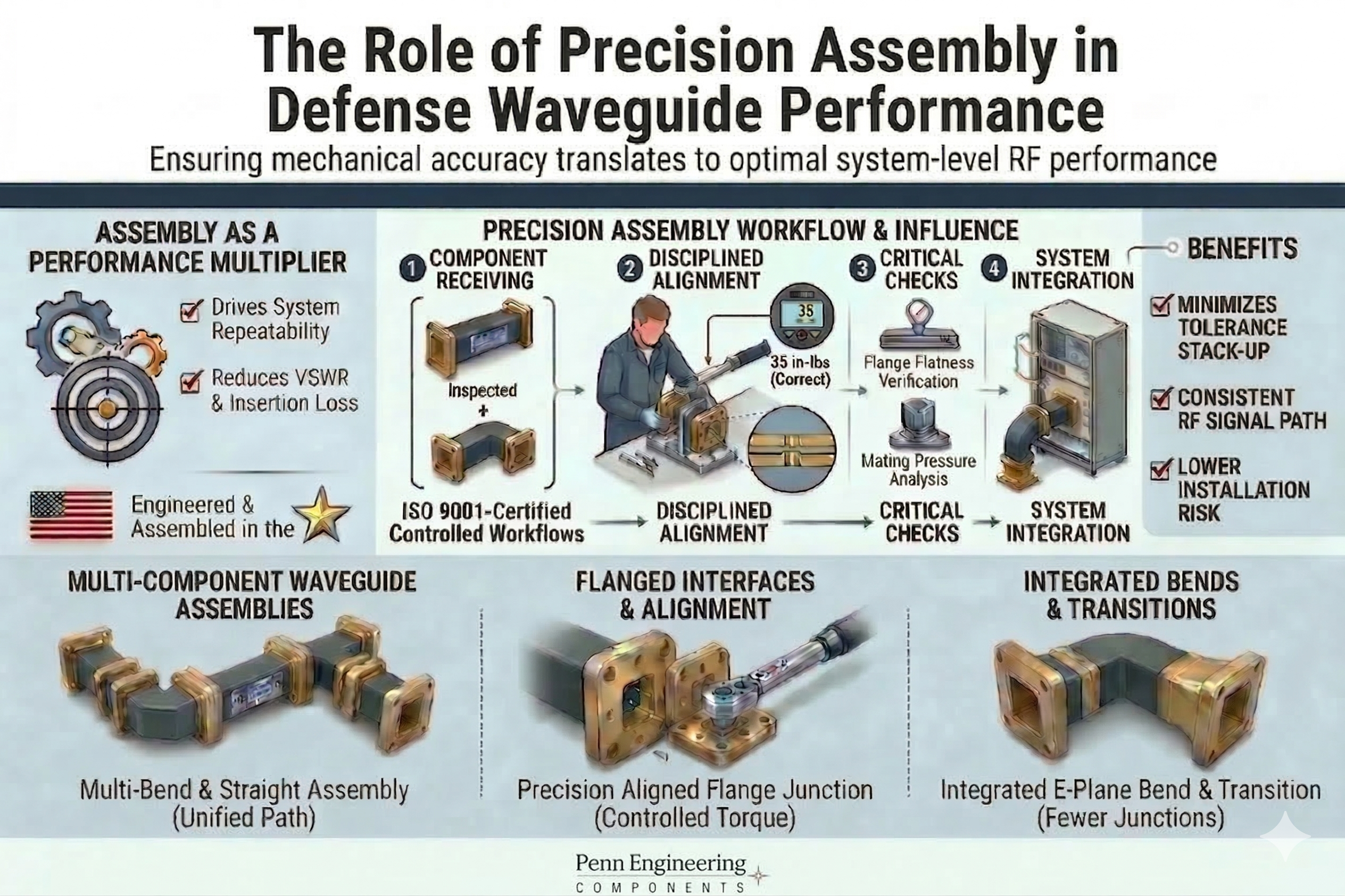
Assembly as a Performance Multiplier
Precision assembly is not an afterthought — it is a performance multiplier.
Manufacturing waveguide assemblies in the United States under ISO 9001-certified processes supports:
- Controlled assembly workflows
- Documented inspection procedures
- Repeatable production quality
- Shorter feedback loops between engineering and manufacturing
In defense systems, where performance margins are tight and reliability expectations are high, precision assembly protects signal integrity from design through deployment.
Penn Engineering Components manufactures precision compact waveguide assemblies, custom transitions, and tight-tolerance flanges engineered to meet the mechanical and dimensional demands of aerospace and defense avionics applications.
Explore defense ready waveguide components or request a quote to discuss components built to your drawings and specifications.
Connect With Our Sales Team
To discuss your defense systems and waveguide requirements