
Optimizing Point-to-Point Microwave Performance: The Impact of Mechanical Tolerances
When engineering a new link, it is natural to start by comparing datasheet insertion loss numbers. However, backhaul engineers often discover that the exceptional performance promised on paper doesn’t always translate to the tower.
When you select point-to-point microwave components, relying solely on nominal specifications can leave your network vulnerable to unexpected signal degradation. Here is what your spec sheet might be leaving out—and how to account for it in the field.
Nominal Specs vs. Worst-Case Production Tolerance
It is easy to publish the performance of a “golden unit.” Many datasheets highlight impressive one-time measurements rather than worst-case production tolerances. When calculating your link budget, you need to know how the 100th unit off the line performs, not just the first. If your manufacturer cannot hold tight, consistent production tolerances, the insertion loss you modeled will not be the insertion loss you get.
The Hidden Impact of Straightness Tolerances
Tolerance accumulation across a link can quickly derail signal integrity. In a microwave backhaul waveguide assembly, straightness tolerance directly impacts how well flanges mate during a field installation. You must minimize these microscopic misalignments, as poor straightness creates impedance mismatches at the flange interface.
Maintaining Consistent VSWR Backhaul Performance
When flanges do not align tightly due to mechanical variations, reflections occur. This degrades your waveguide VSWR backhaul performance, ultimately squeezing your margin for error and reducing data throughput. Consistent mechanical specs matter just as much as electrical specs because they are engineered for repeatable installation and predictable performance in harsh outdoor environments.
Don’t let production variations compromise your backhaul network. Focus on suppliers whose electrical performance and mechanical tolerances are verified to spec at volume.
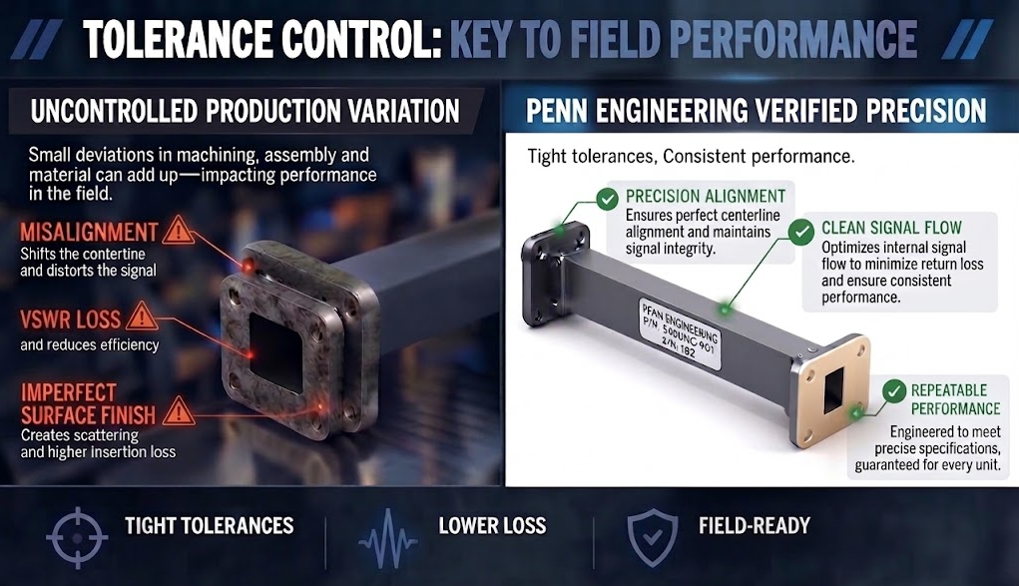
At Penn Engineering, our precision machining processes are engineered for the demands of microwave backhaul waveguide systems. We hold the tight dimensional tolerances that minimize VSWR degradation, delivering the consistent mechanical precision your point-to-point networks need for reliable field performance.
Need tight-tolerance components engineered for your next point-to-point link?
Connect With Our Sales Team
To discuss your defense systems and waveguide requirements